about us
News Center
Your current location:Home - About us - News center
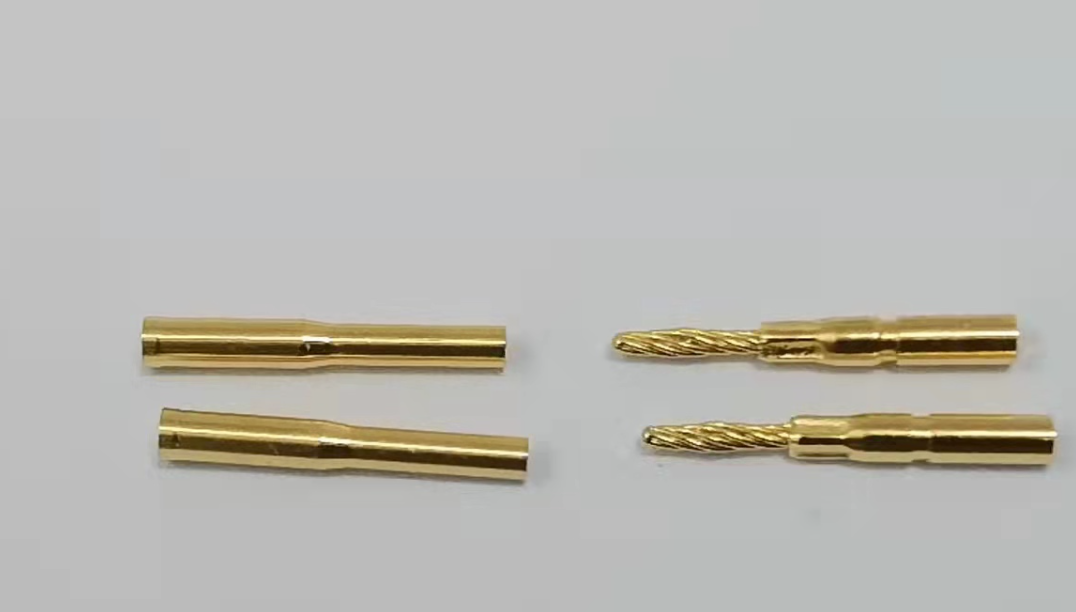
In this product
family, C17200 is the needle wire. It is not the whole connector, and it is not
the pin body. The wire is formed into the elastic strands that make up the
twist pin. The pin body uses C2680 brass. Keeping those roles separate matters
because each alloy carries a different part of the load. C17200 is selected for
its spring behavior in fine wire form, while C2680 brass provides the body
structure and current path. The gold plating and the 80 microinch underplate
sit over the contact surfaces to protect the interface.
Elastic recovery is
the ability of a material to return toward its original shape after being
deflected. In a twist pin, the needle wire strands flex as the contact engages.
That flex creates pressure against the mating surface. If the material has good
elastic recovery, it keeps pushing back instead of taking a permanent set. That
is the core reason C17200 beryllium copper appears in precision spring
contacts. It combines high strength with enough spring range to be wound into
fine strands and then survive repeated deflection. At temperatures from -65°C
to +125°C, the material must resist stress relaxation well enough to keep the
contact interface stable. The wire also has to be weldable and plateable,
because the ends are laser-welded and the surface receives gold plating. A
spring alloy that cannot be processed into that final form is not useful, no
matter how good its datasheet looks.
C17200 is not the
highest-conductivity copper alloy available. That is not the design goal. The
goal is to combine useful conductivity with spring strength and fatigue
resistance. In a twist pin, current passes through multiple contact points
created by the elastic wire strands. The bulk conductivity of the wire matters,
but the contact resistance is strongly influenced by the interface: pressure,
surface finish, plating, and freedom from oxide films. Fatigue resistance
matters because the wire strands flex during mating, vibration, and thermal
movement. A material that conducts well but cracks or relaxes early will not
keep a stable low-resistance path. The confirmed product information gives a
nominal mechanical life of 1000 mating cycles. Higher cycle expectations depend
on plating thickness, custom requirements, and the actual application
conditions. For standard C17200 twist pin wires, the practical value is the
combination: enough conductivity for 1A, 3A, or 5A contacts, and enough spring
endurance to keep the contact pair working.